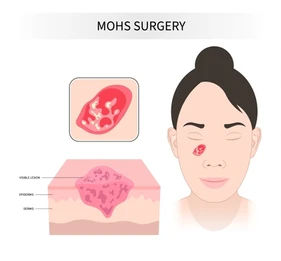
What Is Mohs Surgery and How Is It Done?

If you or a loved one has recently been diagnosed with skin cancer, your dermatologist may have mentioned Mohs surgery as a treatment option. While the name might sound intimidating, Mohs surgery is widely considered the gold standard for treating many types of skin cancer, offering the highest cure rates while sparing as much healthy tissue as possible. In this post, we'll walk through exactly what Mohs surgery is, who it's for, and what to expect from start to finish.
A Quick History
Mohs surgery is named after Dr. Frederic Mohs, the surgeon who developed the technique in the late 1930s at the University of Wisconsin. Originally called "chemosurgery" because of the chemical paste Dr. Mohs used to fix the tissue, the procedure has evolved significantly over the decades. Today's Mohs micrographic surgery uses fresh-tissue techniques and modern microscopy, but the core principle remains the same: remove cancer one thin layer at a time and examine each layer under a microscope until no cancer cells remain.
What Makes Mohs Surgery Different
Standard skin cancer excisions remove the visible tumor along with a margin of surrounding tissue, which is then sent to a lab for analysis. Results may take days, and if cancer cells are found at the edges of the removed tissue, a second surgery is often needed.
Mohs surgery flips this process on its head. The surgeon removes the cancer in extremely thin layers and examines each one under a microscope on the spot, while you wait. Only the areas that still contain cancer are removed in subsequent layers. This approach allows for two important advantages: the highest possible cure rate, often 99% for previously untreated skin cancers, and the smallest possible wound, since healthy tissue is preserved.
Who Is a Good Candidate
Mohs surgery is most often recommended for basal cell carcinoma and squamous cell carcinoma, the two most common forms of skin cancer. It is particularly valuable when the cancer is located in cosmetically or functionally sensitive areas such as the face, ears, scalp, hands, feet, or genitals; when the cancer is large, aggressive, or has poorly defined borders; when the cancer has recurred after a previous treatment; or when the patient has a weakened immune system. Melanoma and rarer skin cancers may also be treated with Mohs, depending on the case.
Step by Step: How the Procedure Works
Mohs surgery is typically performed in an outpatient setting under local anesthesia, meaning you stay awake but the area being treated is completely numb. Most patients can drive themselves home afterward.
The day begins with the surgeon marking the visible tumor and injecting a local anesthetic. Once the area is numb, the surgeon removes the visible cancer along with a very thin layer of surrounding tissue. This first layer is carefully mapped. A bandage is applied, and you return to the waiting area.
Behind the scenes, a histotechnician processes the tissue, freezing it, slicing it into ultra-thin sections, and mounting it on slides. The Mohs surgeon then examines these slides under a microscope, checking the entire deep edge and outer edge of the removed tissue for any remaining cancer cells.
If any cancer cells are visible at the margins, the surgeon returns to you, numbs the area again if needed, and removes another thin layer, but only from the precise spot where cancer was detected. This process repeats, layer by layer, until the microscope shows clear margins all the way around. Most cancers are cleared in one to three layers, though more complex cases can take longer. From start to finish, expect to spend anywhere from two to six hours at the office, much of which is waiting between layers.
Once the cancer is fully removed, the surgeon discusses how to repair the wound. Small wounds may be left to heal on their own, while larger ones can be closed with stitches, a skin flap, or a skin graft. In most cases, the same surgeon performs the reconstruction immediately after clearing the cancer.
Recovery and Aftercare
Recovery from Mohs surgery is generally smooth. You'll go home with detailed wound care instructions, which usually involve keeping the area clean, applying ointment, and changing the dressing daily. Some bruising, swelling, and mild discomfort are normal for the first few days and can typically be managed with over-the-counter pain relievers.
Stitches are usually removed within one to two weeks, depending on location. Scars from Mohs surgery tend to fade significantly over six months to a year, and because the technique preserves so much healthy tissue, cosmetic outcomes are often excellent.
Risks to Be Aware Of
Like any surgical procedure, Mohs carries some risks, though serious complications are rare. Possible issues include bleeding, infection, scarring, temporary or permanent numbness near the surgical site, and, very rarely, recurrence of the cancer. Choosing a fellowship-trained Mohs surgeon significantly reduces these risks.
Why Patients Choose Mohs
For patients facing skin cancer, especially in visible or delicate areas, Mohs surgery offers a rare combination of benefits: extremely high cure rates, immediate results, minimal removal of healthy tissue, and same-day reconstruction. Knowing the cancer is gone before you leave the office provides a peace of mind that few other treatments can match.
Talk to Your Dermatologist
If you've been diagnosed with skin cancer, ask your dermatologist whether Mohs surgery is right for your situation. Not every skin cancer requires Mohs, but for the cases where it's appropriate, it remains one of the most effective tools modern dermatology has to offer. Early detection and the right treatment plan are the keys to the best possible outcome, so don't put off that skin check or follow-up appointment.
If you have questions about a recent diagnosis or want to learn more about your treatment options, reach out to our office. We're here to help you understand every step of the process and feel confident in the care you receive.
Please call us at (520) 382 - 3330 if you have any questions or want to book your Moh's surgery today.